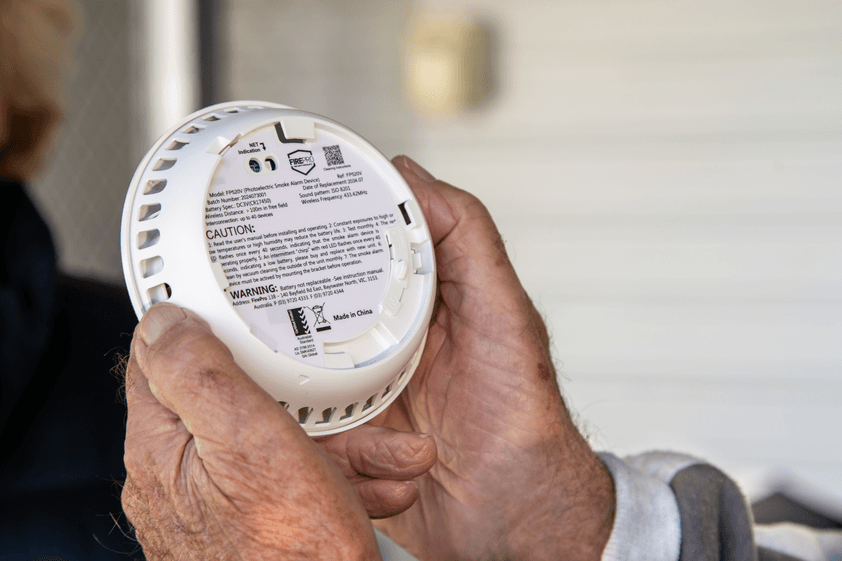
By 1 January 2027, all Queensland homes must comply with new interconnected photoelectric smoke alarm legislation.
What changes on 1 January 2027?
From 1 January 2027, all owner occupier homes (existing private houses, townhouses and units) in Queensland must meet the same smoke alarm standards that already apply to rental properties.
This means your smoke alarms must:
- Be photoelectric (Type A)
- Comply with the Australian Standard AS3786-2014. (The alarm must be marked with AS3786-2014)
- Be hardwired (e.g. 240Vac) to the mains power supply
- Have a secondary power source (i.e. 9V removeable battery or non-removable 10-year battery) or;
- Be interconnected with every other smoke alarm in the property so all alarms activate together
- Must not contain an ionisation sensor
Every Queensland home must have interconnected photoelectric smoke alarms installed in all required locations by the 2027 deadline. If you live in your property (i.e. you are an owner occupier) and your alarms are older, standalone or installed only in hallways, there is a strong chance smoke alarm upgrades will be required.
Now is the time to act. Waiting until late 2026 may mean delays as smoke alarm upgrade demand increases across Brisbane and South East Queensland.
Where smoke alarms must be installed in QLD homes
Under Queensland smoke alarm legislation, interconnected photoelectric smoke alarms must be installed:
- On each storey of the dwelling
- In every bedroom
- In hallways that connect bedrooms and the rest of the dwelling
- If there is no hallway, between the bedroom and other parts of the storey
- If there are no bedrooms on a storey, in the most likely path of travel to exit the dwelling
When one smoke alarm activates, all interconnected alarms must sound together. This significantly increases early warning time, especially in larger homes.
Why are Queensland smoke alarm laws changing?
On 31 August 2016, Queensland Parliament passed smoke alarm legislation following recommendations handed down after the 2011 Slacks Creek house fire which tragically claimed 11 lives. These reforms were introduced to improve early fire detection and reduce loss of life in residential house fires.
All rental properties (and homes or units being sold) required photoelectric interconnected smoke alarms by 31 December 2021. This means:
- Any new smoke alarm installed had to be photoelectric
- Any replaced alarm had to be photoelectric
- All alarms had to comply with Australian Standard AS 3786:2014
- Hardwired alarms had to be replaced with hardwired photoelectric alarms
- Any alarm that did not operate when tested also had to be replaced
This marked the beginning of Queensland’s transition away from older ionisation smoke alarms. Now the legislation is changing to require all owner occupier homes, townhouses and units in Queensland to meet the same compliance requirements.
What is a photoelectric smoke alarm?
As outlined by Queensland Fire and Emergency Services, photoelectric smoke alarms detect visible particles of combustion. They respond to a wide range of fires and are particularly responsive to smouldering fires and dense smoke from foam-filled furnishings or overheated PVC wiring.
Photoelectric alarms provide earlier warning in many real-world house fire scenarios compared to older ionisation alarms. Further technical details are available from Queensland Fire and Emergency Services.
What are QLD rental property smoke alarm laws?
By 31 December 2021, all rental properties in Queensland were required to comply with the full interconnected photoelectric smoke alarm legislation.
This included:
- Installation in all required locations
- Interconnection between alarms
- Replacement of non compliant alarms
- Alarm compliance with AS 3786:2014
Rental properties have been required to comply with interconnected smoke alarm legislation since 31 December 2021.
Substantial penalties can apply for non compliance, along with increased liability risk.
Smoke alarm compliance when selling a property
Since 1 January 2022, properties being sold in Queensland must comply with current interconnected smoke alarm legislation before settlement.
Buyers increasingly request compliance confirmation. Ensuring your property meets legislation early can help avoid delays during the sale process. Learn more about smoke alarm compliance certificates.
Window covering safety standards
In addition to smoke alarm legislation, a safety standard was introduced by the Australian Competition and Consumer Commission under the Competition and Consumer Act 2010. This standard addresses the risk of strangulation from loop cord systems attached to window coverings such as blinds and curtains.
Any hanging cord capable of forming a loop of 220mm or more that hangs 1600mm or lower from the floor must be secured or tensioned.
Landlords are responsible for ensuring compliance with these safety standards. Penalties for breaches can reach $220,000 for individuals and $1.1 million for companies. Beyond financial penalties, there is also the risk of serious injury and subsequent compensation claims.
Understanding your smoke alarm compliance obligations
Queensland smoke alarm legislation has evolved over time, but the final stage arrives on 1 January 2027. If your home was built before these reforms and has not been upgraded, it may not meet current requirements.
Homes commonly require upgrades where:
- Smoke alarms are older than ten years
- Alarms are not photoelectric
- Alarms are not interconnected
- Bedrooms do not have individual alarms
If your alarms are not photoelectric and interconnected in every required location, your home will not comply after 1 January 2027.
Reviewing your smoke alarm compliance now gives you time to plan a fire alarm upgrade properly rather than rushing as the 2027 Queensland smoke alarm deadline approaches.

About Jason Lee
Jason is the owner and lead technician at Queensland Fire Alarms and Compliance. He’s been doing smoke alarm upgrades, installations and maintenance in Brisbane and SEQLD for over 15 years.